

Maquila Law in Paraguay for companies that want to expand beyond its borders.


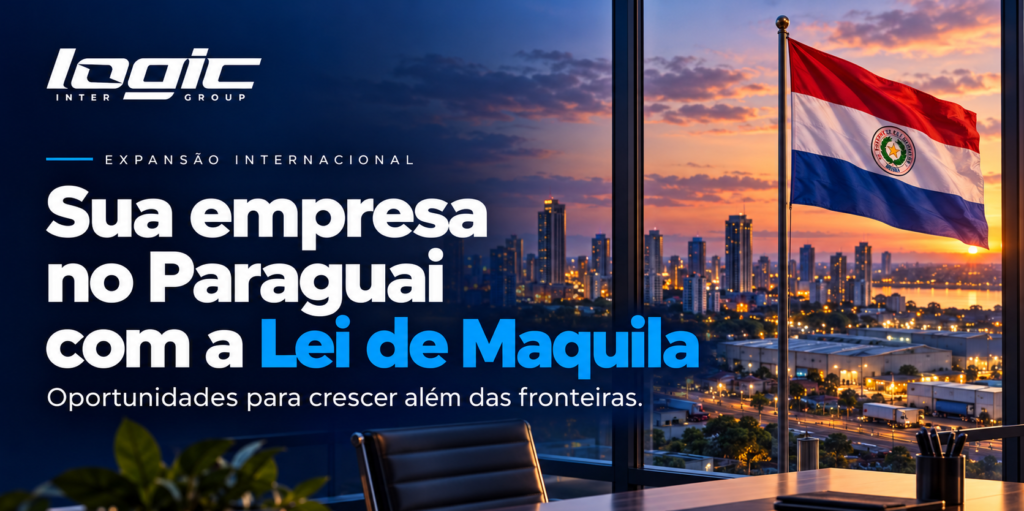
Understand how the system works, what benefits it offers, and what to consider before moving your operations to the neighboring country.
Your company sells, works, and grows, but the margin remains tight? For entrepreneurs seeking new paths, evaluating an operation in Paraguay could be part of an expansion strategy. The Maquila Law is one possibility for businesses with production or services destined for export.
The attractiveness of the 1% tax is appealing. However, the decision needs to consider the operation's functioning, implementation costs, logistics, and obligations in the countries involved. This analysis helps transform a legally mandated benefit into a real business opportunity.

What is the Maquila Law and how does it work?
Maquila allows a company established in Paraguay to perform industrial processes or services for a company abroad, under contract. The operation incorporates Paraguayan resources and focuses on exports.
A Brazilian company can, for example, contract a Paraguayan operation to assemble products destined for export. The classification depends on the characteristics of the project and the approved program.
The current system is governed by Law No. 7,547/2025 and Decree No. 5,714/2026. A new project must take these rules into account in an updated format.
The 1 percent tax requires careful calculation.
The legislation provides for a single tax of 1% on the value added in Paraguayan territory or on the value of the export invoice, whichever is greater. The benefit is linked to activities carried out within the approved program.
This means that the percentage alone doesn't reveal how much your company will pay. First, it's necessary to identify the correct calculation basis and understand which values are included in that calculation.
For illustrative purposes only: if the calculated added value is US$80,000 and the export invoice considered is US$100,000, the calculation will be based on US$100,000. In this scenario, the single tax will be US$1,000. The actual calculation depends on the documents and characteristics of the transaction.
The benefits need to be reflected in the final cost.
The regime also provides benefits for authorized temporary imports of goods necessary for the process. Its use depends on compliance with the legal conditions and required controls.
For entrepreneurs, the most useful question is how much it costs to produce, deliver, and receive payment for the sale after adding up all expenses. This assessment includes physical infrastructure, staff, energy, transportation, insurance, currency exchange, accounting, and capital to keep the operation running.
Tax savings can be significant. However, their effect on the bottom line needs to be calculated along with other costs and the expected sales volume. 
Maquila and common taxation have different rules.
In the common Paraguayan system, the corporate income tax has a rate of 10% in the General and SIMPLE regimes. The VAT has rates of 5% and 10%, depending on the operation. These percentages should not simply be added to the single Maquila tax: each activity needs to be analyzed according to its regime and classification.
Selling to Mercosur requires looking at the product's origin.
Being based in Paraguay can be part of a strategy to serve clients in the region. Access to preferential tariffs within Mercosur, however, depends on compliance with rules of origin and the documentation applicable to the product.
In simple terms, it is necessary to verify how the good was produced and what inputs were used. Opening a company in the country or participating in the Maquila scheme, in itself, does not guarantee preferential treatment.
When the destination of the goods is Brazil, it is also necessary to assess the tax treatment and controls required for importation. The simulation should consider the classification of the goods and the conditions of the operation.
Having a company in Paraguay also requires attention to Brazil.
In Paraguayan law, corporate income tax considers income originating from Paraguay, but this does not mean that a partner residing in Brazil is exempt from Brazilian obligations. Holdings, profits, and income abroad must be assessed according to the legislation applicable to the investor.
For this reason, the project must consider both the company in Paraguay and the situation of the partners and businesses maintained in Brazil. Looking only at the foreign tax rate may leave out an important part of the calculation.
Before opening the company, design the operation.
An initial analysis should answer specific questions:
- What activity will be carried out in Paraguay and who will be the client abroad?
- Which stages of production or service provision will take place in the country?
- How much will be needed to invest, and what sales volume will sustain the operation?
- How will contracts, payments, transportation, and delivery be organized?
- What obligations need to be met in Paraguay and Brazil?
With these answers, it becomes easier to compare scenarios and assess eligibility. Access to the program requires registration and approval by the Maquila Program; opening the business is only one step.
Want to understand if this structure makes sense for your business? Talk to the Logic team about your expansion project.
Expansion begins with information and monitoring.
Implementation needs to be accompanied by an organized routine. Documents, accounting records, contracts, and operational controls help keep the project aligned with the approved conditions and give the business owner a clearer view of the results.
It's also important to track the difference between what was planned and what actually happens. Changes in freight costs, exchange rates, order volume, or delivery times can alter expected profitability. Accounting helps ensure that these decisions are made with up-to-date figures.
Plan your business in Paraguay with Logic.
The Maquila Law can open opportunities for Brazilian companies seeking to expand their international operations. The best starting point is to understand if the model meets the needs of your business and what steps will be necessary to put it into operation.
Logic offers support for opening and managing business accounts in Brazil and Paraguay. With guidance that considers the legislation of both countries, you can organize the next steps in your expansion and assess the responsibilities involved.
Your business can go beyond borders. Start with a conversation that puts your project and your numbers at the center of the decision.
Speak to a Logic expert.
Email: comercial@logicassessoria.com.br
WhatsApp: (62) 9277 – 2270
Linktree: linktr.ee/logicoficial
Frequently asked questions about the Maquila Law
Does every company opened in Paraguay pay only 1% in taxes?
No. The single tax is specific to Maquila and depends on eligibility, approval, and compliance with the regime's conditions.
Can maquila also be used for services?
Yes. The scheme covers services intended for use abroad, provided that the applicable requirements are met.
Can I make the decision solely based on tax savings?
The decision must consider the full cost, demand, logistics, initial investment, and obligations in the countries involved. The expected savings must make sense in the final outcome.